Contents
- The Rustic Cliché Conundrum
- The Environmental Challenge at Chanteclaire Farm
- Strategic Illumination and Composition
- Scope and Adaptability in Mountain Climates
- The Editorial Result and Narrative Cohesion
The Rustic Cliché Conundrum
Why do so many barn wedding galleries look the same? I asked myself this question before ever stepping foot on the property at Chanteclaire Farm, and the answer arrived only after I sat down and audited a stack of galleries from comparable venues. The pattern was almost embarrassing in its consistency: flat tonal curves, desaturated greens, and a uniform haze applied as though softness itself were a substitute for intention.
There is a tension at the heart of rustic photography that rarely gets named. We want authenticity. We also want elegance. The default assumption is that these two ambitions pull against each other—that to honor the weathered wood and the open field you must surrender any aspiration toward editorial polish.
I do not accept that premise.
The creative direction for this project began with a deliberate pivot away from the muted, over-filtered look toward something with high contrast and a cinematic editorial weight. The reasoning is first-principles: a barn is not a soft place. It is a structure of hard angles, deep shadow, and dramatic light. Photographing it as though it were gauzy and pastel is a denial of what the architecture actually is.
Chanteclaire Farm became my testing ground precisely because it refuses to be flattered by lazy technique. It demands that documentary realism and cinematic control coexist in the same frame. The question that follows is simple to state and difficult to execute: can you preserve the truth of a place while still elevating it?
The Environmental Challenge at Chanteclaire Farm
The first hurdle is light, and the barn does not make it easy.
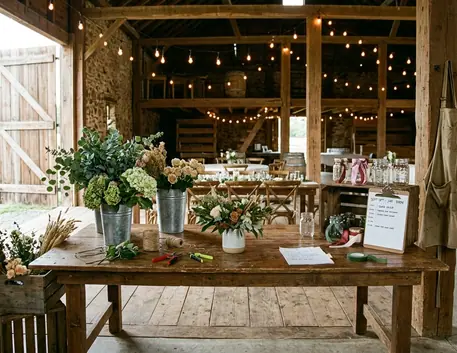
When I metered the main reception space, the numbers told a brutal story. Between the cavernous interior corners—where the dark wood swallows light whole, and the midday sun pouring through the open main doors, I measured an exposure difference of five to seven stops. No single exposure holds both ends of that range gracefully. Something has to give.
The tempting shortcut is to expose for the interior shadows and let the open doors blow out to a clean white. I rejected that approach early. Those doors frame the venue's defining landscape, the rolling Deep Creek Lake, Maryland terrain that gives the place its identity. Erasing that view to simplify the exposure would be solving a technical problem by creating an editorial one.
The environment compounds the difficulty. The microclimate around Deep Creek Lake is genuinely volatile—harsh, directional midday sun can give way to heavy mountain overcast in the span of a short coffee break. You do not get to plan around the weather here. You plan around the fact that the weather will not cooperate.
The Wood Itself Is a Variable
One factor that surprises photographers new to barn venues: the wood treatment changes everything. A dark, light-absorbing matte stain demands far more flash power than a reflective clear coat. Walking the space and noting how the surfaces behave before the first guest arrives is not optional preparation. It is the difference between a controlled session and an improvised scramble.
Strategic Illumination and Composition
If the barn absorbs light, the answer is to bring controlled light to it—but carefully, so the venue still feels like itself.
The existing string lights are part of Chanteclaire's character. Their warm tungsten glow is the ambient signature of the room, and any solution that drowned them out in favor of clinical strobe light would have betrayed the atmosphere. So the goal became preservation, not replacement.
I positioned off-camera strobes high in the rafters, elevated somewhere around twelve to fourteen feet on heavy-duty stands, and dialed the power down manually. The strobes sculpt the subjects without flattening the scene. To register the ambient tungsten bulbs, I dragged the shutter into a range in the neighborhood of one-thirtieth to one-sixtieth of a second. That single adjustment lets the string lights breathe in the frame rather than vanish into underexposed black.
Why Height Matters: The Inverse Square Law
Working in an expansive, light-absorbing wooden structure forces you to respect the physics. Light falls off according to the inverse square law of light, and in a cavernous barn that falloff is unforgiving. Placing the strobes high and pulling them back gives a more gradual transition across the subjects, rather than a hot, collapsing pool of light that dies a few feet from the source.
Framing With What the Venue Gives You
Composition followed the same principle of working with the structure rather than against it. The venue's iconic silo and the surrounding foliage became natural framing devices—elements that build depth of field and lead the eye without any artificial set dressing. The architecture wants to be photographed a certain way. Listening to it is half the work.
Field Note: Before lifting a single light, walk the room and find your structural anchor points. The rafters and lofts at Chanteclaire are not just charming details—they are mounting positions that let you place light above the subjects, where it belongs.
Scope and Adaptability in Mountain Climates
Here is where theory meets the squall.
During one portrait session, a sudden mountain storm rolled in from across the lake. The planned open-field portraits were no longer viable—not in close to fifteen to twenty minutes, which is all the warning the microclimate offered. A rigid shot list would have collapsed under that pressure. Instead, the team pivoted to the venue's covered structures, reworking the timeline on the fly.
This is the argument against relying solely on natural light in Western Maryland. The weather is not a backdrop you can assume. It is an active participant, and the photographer who treats a printed shot list as gospel will be photographing the wrong scene at the wrong moment.
A fluid, reactive approach is the only honest response to a dynamic environment. But fluidity has a cost worth naming plainly.
Important: Executing rapid off-camera flash adjustments during sudden weather shifts requires a dedicated lighting assistant. This approach is highly impractical for solo photographers, and I would not pretend otherwise.
Where Editorial Intervention Stops
There is a boundary I do not cross. Enhancing a scene means shaping the light that is already there, accentuating the texture of the wood, and giving the couple a portrait worthy of the setting. It does not mean fabricating a narrative that never happened. The squall was real. The pivot to the silo was real. The gallery should reflect the day as it unfolded, not a fictional version assembled in post.
Cross-checking the final files against the raw captures confirmed this discipline held. The intervention was in service of the truth, not in place of it.
The Editorial Result and Narrative Cohesion
A gallery is not a pile of good images. It is a sequence, and the sequence carries meaning.
During the final curation phase, I sequenced the gallery to alternate deliberately: wide, ambient-lit architectural establishing shots followed by tightly cropped, flash-sculpted portraits. That rhythm mirrors how the day actually felt—the expansive sense of the venue punctuated by intimate, deliberate moments. The pacing does the storytelling.
The technical solutions earned their place by serving this larger goal. The dragged shutter that preserved the string lights, the rafter-mounted strobes, the framing through the silo and foliage—none of it exists for its own sake. Each choice elevated the venue's natural beauty while keeping the couple's authentic story intact.
What I take away from Chanteclaire is broader than a single wedding. Treating a rustic venue with a disciplined, high-fashion approach does not strip away its character. Done with restraint, it reveals character that a softer, more clichéd approach would have buried under a haze of desaturation.
Bottom Line: The rustic and the editorial are not opposites. With deliberate light, structural framing, and an honest respect for the weather, a barn at Deep Creek Lake can hold both documentary truth and cinematic elegance in the same frame.
The cliché was never the venue's fault. It was a failure of intention—and intention is the one variable fully within our control.