The modern wedding album has quietly become a mirror of itself. Scroll through a hundred of them and you start to notice the same golden-hour silhouette, the same confetti toss frozen mid-air, the same couple running through sparklers while a phantom wind catches the veil. The location changes. The composition rarely does.
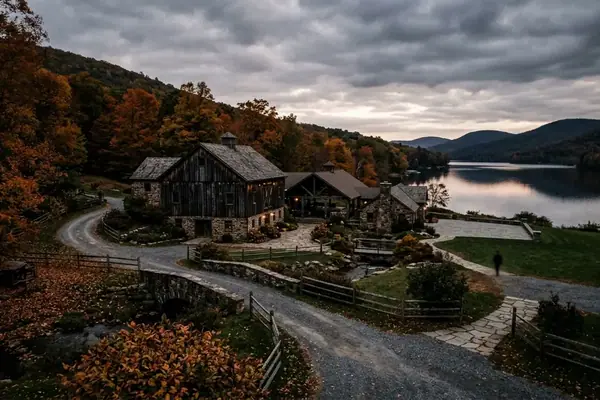
I have spent ten years photographing weddings across Pennsylvania and Maryland, from the rustic barns near Deep Creek Lake, MD to the worn stone chapels that predate the country itself. And the longer I do this work, the more convinced I become that the images couples treasure most are the ones that quietly refuse to follow the trend of the moment.
The Homogenization of the Modern Wedding Album
There is a tension at the heart of contemporary wedding photography, and I think most couples feel it without naming it. On one side sits the pull to stage a moment built for a feed: the directed embrace, the perfectly backlit kiss, the shot that already exists in a thousand other galleries. On the other sits the messy, unrepeatable reality of two families colliding for a single afternoon.
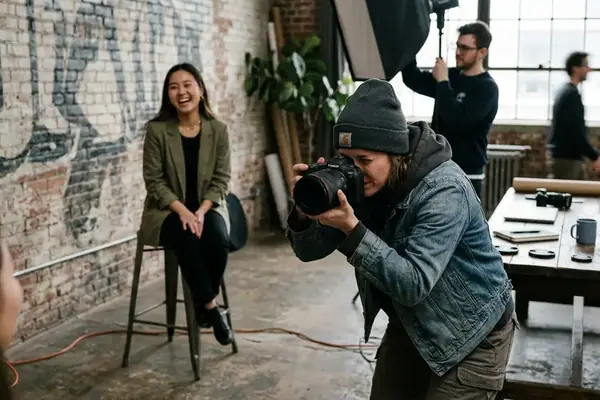
When I am working a reception, I rarely direct the people I am photographing. I watch the edges of the room instead. The grandmother who tears up during a toast nobody planned. The flower girl asleep under a table. The unprompted reactions tend to arrive when you stop asking for them.
My thesis is simple, and a decade of prints has earned it: the most enduring images are the ones that resist whatever aesthetic happens to be fashionable the year they were taken.
The Illusion of the 'Perfect' Shot in the Mid-Atlantic
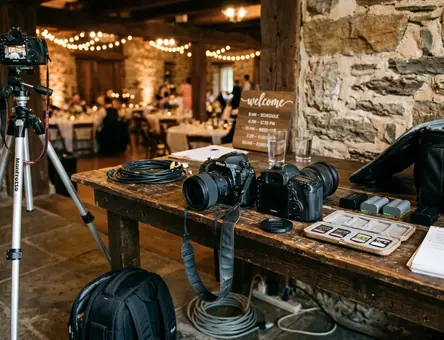
Couples arrive at consultations carrying screenshots. Bright, airy, sun-drenched frames pulled from accounts photographed in California fields under reliable light. The psychological pressure to recreate those exact images is real, and I understand it. But the Mid-Atlantic does not cooperate.
Consider an 18th-century stone estate with deep walls and minimal window light. Consider a late-autumn afternoon where the usable light collapses close to the 3:45 to 4:15 PM window, faster than most clients expect. These rooms were never built for the bright-and-airy preset, and forcing one onto them produces something that feels neither true to the place nor to the day.
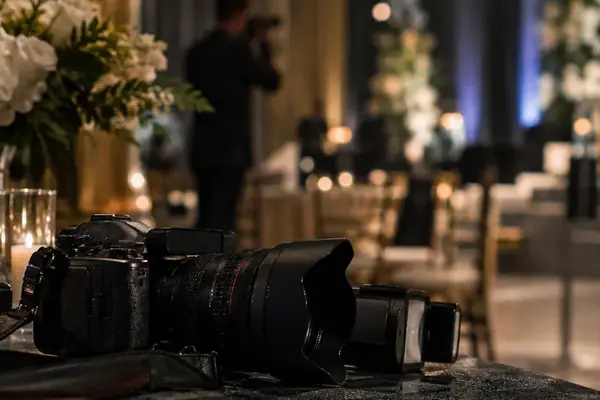
Early in my career, the instinct in those dim historic interiors was to flood them with multi-point strobe setups until the space read as bright. I abandoned that approach. A fast prime lens, opened wide, lets the room keep its own shadows and its own mood. The estate gets to look like itself.
Rain on a cobblestone courtyard. The hard, raking shadow of a low November sun across a stone wall. These are not flaws to be corrected in post. They are the honest record of an actual day in an actual place, and they carry more emotional weight than any sanitized version ever could.
A Decade of Observation: What Actually Lasts
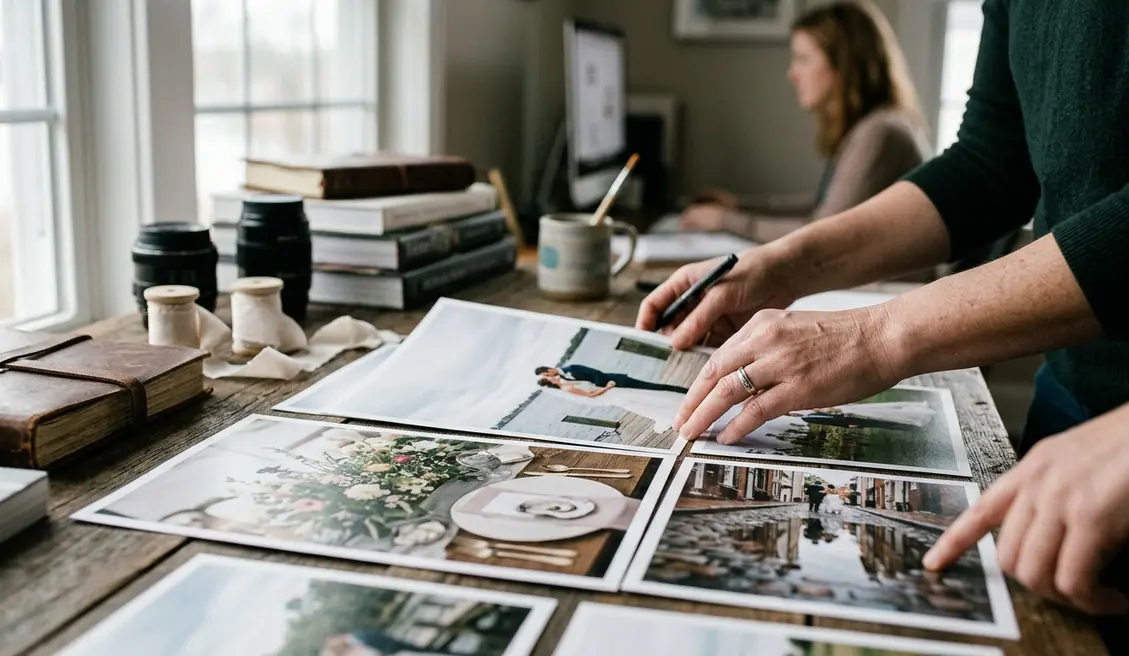
I wanted to know what couples truly valued, not what they said they valued during planning. So I started cross-referencing two documents: the formal shot list submitted before the wedding, and the physical print and album order that arrived somewhere around six to nine months later.
The gap between them is the whole story.
Couples who requested meticulous posed portraits consistently ordered something else for their walls. A fleeting glance exchanged across a chaotic reception. A father's hand on a shoulder. The unscripted frame they never asked for, reviewed across multiple seasons, tended to outlast the carefully composed one.
This raises a question worth sitting with: why do some photographs hold their emotional charge while others curdle into nostalgia for their own editing software? The desaturated greens that dominated wedding work in the mid-2010s now read instantly as a period stamp, the same way the heavy sepia of the early 2000s does. The edit dated the image faster than the dress ever could.
The photographs that endure are not the ones that captured a trend perfectly. They are the ones that captured a person honestly, and then got out of the way.
This is also where I think the act of relentless staging quietly costs us something. There is psychological research on how excessive photo-taking and staging can actually impair human memory of the very event being documented. The more we perform a moment for the camera, the less of it we may actually keep.
The Inherent Limitations of 'Timelessness'
I should be honest about a counter-argument, because it is a good one. True timelessness is a photographic impossibility. Every era leaves its fingerprints through fashion, through technology, through the cultural shorthand of how people stand and where they look. A wedding from somewhere around 1975 announces its decade the moment you see it, and there is nothing wrong with that.
Important: This documentary-first editing philosophy asks something of clients in return. You have to accept minor environmental imperfections and the occasional stray hair, because heavy localized retouching inherently reintroduces the modern, artificial aesthetic we were trying to avoid in the first place.So the goal is not to scrub away the temporal context of a wedding. The goal is narrower: to prevent the post-processing and the directorial style from overshadowing the people in the frame.
In practice, this means anchoring my color decisions to something stable rather than fashionable. I calibrate custom profiles to emulate standard 400-speed medium-format color negative film stocks, the analog characteristics that have held up for generations, instead of chasing whatever aggressive digital preset is circulating this season. Film grading ages slowly. Trend grading ages overnight.
There is a line here worth drawing clearly. A photograph that documents an era wears its time as context. A photograph that is a victim of its era wears its time as a flaw introduced by the editing software. The difference is whether the subject or the style is doing the talking.
Reclaiming the Documentary Approach
None of this works if the wedding day itself is engineered against it. A documentary photograph requires a documentary environment, and that environment is built during planning, not on the day. Here is how I guide couples toward it.
Trim the shot list
The exhaustive shot list is the quiet enemy of observation. When a photographer is mentally ticking through nearly forty mandatory frames, there is no attention left over for the unplanned glance that would have become your favorite print. I ask couples to cap the requested formal groupings at in the neighborhood of ten to twelve essentials.
I have watched the alternative play out: a couple spending close to ninety minutes on posed portraits and missing their own cocktail hour entirely. They got the list. They lost the evening.
Protect the timeline
During pre-wedding consultations, we map family dynamics in advance so the formal portraits move quickly. Keeping that session to a strict 20 to 25 minute window frees the rest of the day for pure observation. Consolidate the obligations early, and the unscripted hours open up on their own.
- Map out family groupings and any complicated relationships before the day, not during it.
- Limit formal family portraits to a single tight 20 to 25 minute block.
- Cap essential formal groupings at ten to twelve.
- Leave the reception unscripted, and let the photographer read the room.
Trust the craft
The final shift is the hardest, because it means handing over control. Some of this is technical adaptation a script cannot anticipate, like adjusting shooting distance to the acoustic and spatial constraints of a historic stone chapel where you simply cannot stand where you want to. The rest is trust: in a photographer's reading of light, of composition, of how human beings behave when no one is directing them.
The point: A predetermined visual script can only deliver the images you already imagined. Trusting the photographer's eye is the only way to receive the ones you couldn't.