Contents
- The Architectural Paradox of Historic Spaces
- The Physics of High Ceilings and Mahogany Paneling
- Balancing Ambient Tungsten with Directional Strobes
- Scope and Limitations: Respecting Preservation Guidelines
- Case Studies: Industrial Mills to Gilded Age Libraries
- Embracing the Shadows for Editorial Elegance
The Architectural Paradox of Historic Spaces
Why do the most breathtaking historic venues often yield the most technically flawed photographs?
The answer lies in a fundamental biological discrepancy. Per standard references, digital camera sensors typically clip highlights at 14 to 15 stops of dynamic range, whereas the human eye adapts to somewhere around 20 stops or more in these high-contrast environments. When you walk into a 19th-century cathedral or a converted industrial space, your brain instantly balances the blinding window light with the dark, cavernous corners. A camera sensor simply cannot perform this computational miracle.
This introduces our core conflict: 19th-century architectural design prioritized structural grandeur over natural light distribution. Architects of the era relied on massive windows for daytime illumination and dim gaslight for the evening, leaving vast pockets of the room in perpetual darkness.
To capture these spaces authentically, photographers must actively decide to meter for the venue's delicate highlight details—such as stained glass or sconce flares, allowing the shadows to fall into deep contrast rather than attempting to flatten the scene. How do we bridge the gap between this architectural intent and photographic reality?
The Physics of High Ceilings and Mahogany Paneling
I remember a specific shoot at a historic library where I initially attempted to bounce a bare speedlight off the 40-foot ceiling. That approach was quickly abandoned. The mahogany paneling absorbed the output and returned a muddy, orange-tinted color cast that ruined the skin tones of the subjects.
Whether working in a downtown industrial loft or a timber-framed lodge near Deep Creek Lake, Maryland, cavernous vertical spaces cause light to fall off rapidly. Dark wood and exposed brick act as massive light sinks. They consume photons and reflect back heavy color contamination, making traditional bounce-flash techniques entirely useless.
According to reports on optical physics, this rapid decay of illumination is a strict mathematical certainty. Light intensity drops by 75% when the distance from the flash to the subject doubles from 10 feet to 20 feet.
Academic Sources
For a deeper understanding of this decay, review the inverse square law of light.
Balancing Ambient Tungsten with Directional Strobes
According to published benchmarks, modern daylight-balanced strobes output light at approximately 5600K. Firing these directly into a historic room creates a jarring, clinical aesthetic that destroys the inherent atmosphere. This requires precise color correction to match historic fixtures.
In practice, shutter speeds are intentionally dragged, often somewhere around 1/15s to 1/30s, to allow the in the neighborhood of 2800K ambient glow of the chandeliers to register on the sensor. Once the ambient exposure is locked, we introduce artificial light.
During a recent setup, the lighting assistant tested multiple gel combinations. We ultimately selected a 1/2 CTO (Color Temperature Orange) gel to warm the strobe just enough to blend with the room's practical lights without overpowering them. There is a context-dependent variation here: adjusting CTO gel strength relies heavily on whether the venue uses modern LED Edison replicas or authentic vintage tungsten bulbs.
This methodology creates directional, modified light that mimics natural window light.
Scope and Limitations: Respecting Preservation Guidelines
Working inside certified historic properties means accepting that the building's preservation supersedes your photographic vision. Historic trusts and venue coordinators impose strict limitations regarding equipment placement.
Pressure from equipment is often kept under close to 5 lbs per square inch to protect 19th-century parquet floors. Continuous lighting at nearly 500 watts is often banned entirely to prevent localized heat damage to antique textiles and oil paintings.
During an initial venue walkthrough, we mapped out safe zones. We opted to mount lightweight strobes on existing modern structural supports to minimize our footprint.
Important: Clamping equipment to architectural features is strictly prohibited if the railing or pillar predates the 1920s renovations, requiring freestanding carbon-fiber monopods held by assistants instead.
These physical limitations force photographers to adopt minimalist, highly efficient off-camera flash strategies.
Case Studies: Industrial Mills to Gilded Age Libraries
Consider the specific lighting environment of a typical Baltimore industrial venue. To separate the couple from a visually chaotic background of mixed skylight and tungsten bulbs in a converted mill, the photographer attaches a honeycomb grid to the softbox, feathering the light exclusively onto the subjects. This isolates the subject while letting the background fall into a natural, moody blur.
Gilded Age academic spaces present a different challenge entirely. Here, light must be pushed across vast distances without looking artificial. A 30-degree honeycomb grid is used to restrict light spill, pushing a narrow beam of light 30 to 40 feet across a reading room.
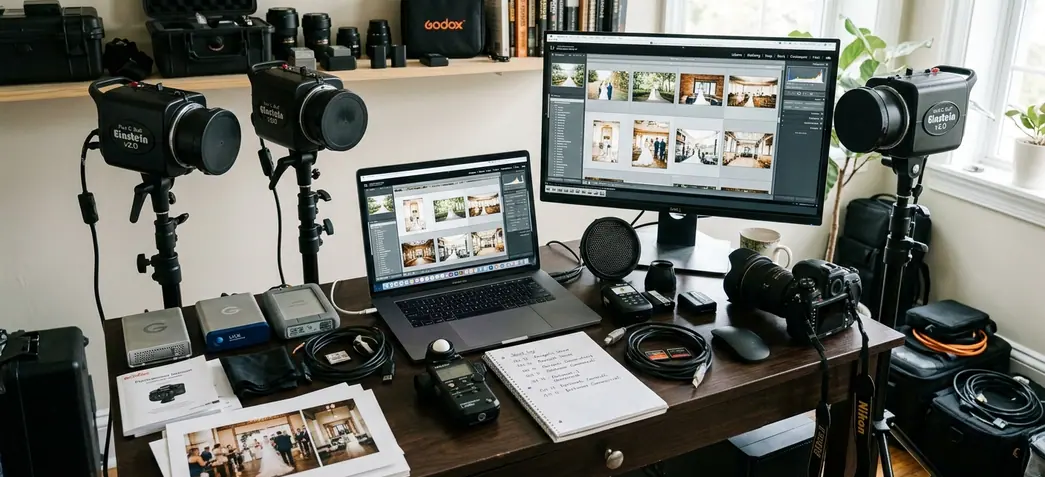
Attempting to overpower a 19th-century library's ambient light with bare strobes often fails, resulting in flat, clinical imagery that destroys the venue's historic atmosphere. Strategic strobe placement, conversely, carves subjects out of deep, historic shadows.
Field Note: Whether shooting in downtown Baltimore or capturing the rustic charm of Deep Creek Lake, MD, controlling light spill is one reliable way to maintain venue ambiance.
Embracing the Shadows for Editorial Elegance
The approach shifts from fixing dark venues to embracing their inherent moodiness. One sure way to ruin a historic space is to light it like a modern office building.
In post-production, the editor makes a deliberate choice to leave the black levels crushed and the shadows unlifted, preserving the authentic, cavernous mood of the venue rather than forcing a brightened, unnatural look.
Deep shadows and dramatic contrast are essential components of high-end, editorial photography. In practice, clients often value the authentic atmosphere of historic Baltimore over artificially flat imagery.
Bottom Line: The true art of venue photography lies in knowing exactly what to leave in the dark.
Further Reading
Explore our related case studies on architectural lighting techniques and commercial brand consistency.