The Midnight Paradox: High Emotion, Low Photons
The climax of any New Year's Eve celebration happens in the most challenging lighting conditions possible. At a recent multi-year contract event near Deep Creek Lake, Maryland, the venue plunged into near-total darkness as the ten-second countdown began. This creates an immediate technical conflict. You must freeze fast-paced celebratory motion while simultaneously gathering sufficient light to render a usable image.
I establish a baseline shutter speed by observing the crowd's kinetic energy during the final hour of the reception. Freezing motion takes priority over optimal light gathering. A blurry photograph of a decisive moment holds no value, regardless of its exposure perfection. This requires a measured approach to overcome severe environmental deficits. We cannot rely on luck when the clock strikes twelve.
Sensor Dynamics and the Physics of ISO Invariance
Modern digital sensors process light in near-darkness through complex analog and digital amplification. Understanding ISO speed ratings and sensor sensitivity standards is critical for predicting how a camera behaves when starved of photons. Many contemporary cameras use a dual-gain sensor architecture switching to the second base circuit somewhere around ISO 640 on certain bodies.
When configuring the camera for the final countdown, the decision was made to lock the sensor at its second base ISO step to protect highlight data from erratic DJ strobes. Underexposing at this base ISO often yields cleaner files than amplifying analog gain in-camera. In practice, this type of ISO invariance allows for aggressive exposure bracketing strategies tailored for unpredictable midnight lighting. The physics dictate that capturing fewer photons at a lower amplification preserves the dynamic range necessary to hold the bright bursts of sparklers or stage lights.
Field Note: Always test your specific camera body to find the exact point where the dual-gain circuit engages before relying on it during a live event.
Case Study: Strategic Off-Camera Flash Implementation
Lighting a dark ballroom during a NYE confetti drop requires precise geometry. To illuminate the confetti drop without destroying the ambient mood, speedlights are positioned at opposite corners of the dance floor. The photographer manually balances the flash output to freeze the falling paper while maintaining the room's atmosphere.
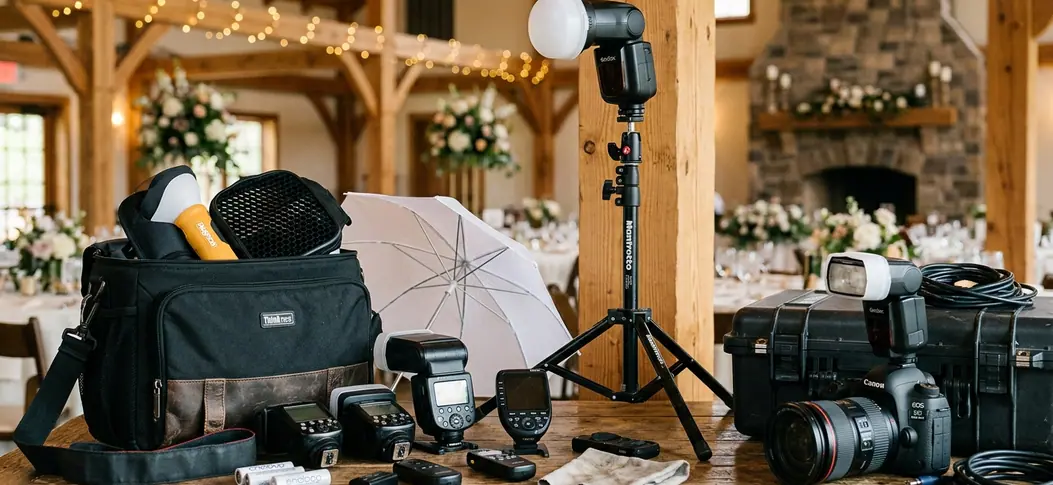
In practice, and according to published benchmarks, manual flash power is set between 1/64 and 1/128 to achieve a flash duration shorter than 1/8000s. This is paired with ambient drag shutter speeds ranging from 1/15s to 1/30s. Rear-curtain sync creates a beautiful sense of motion leading up to a sharp, frozen subject.
There are strict environmental limits to this approach. Rear-curtain sync dragging creates excessive, muddy ghosting if the ambient room light levels rise into the neighborhood of EV 4, rendering the primary subjects indistinguishable from the background motion blur. Flash placement geometry must shift from nearly 45-degree cross-lighting to direct bounce if the venue features low, acoustically-treated white ceilings.
Scope and Limitations of Low-Light Recovery
Software-based noise reduction cannot replace lost structural detail. During the post-production culling phase, files are evaluated for structural integrity in the shadows. The editor determines the cutoff point where applying aggressive luminance noise reduction begins to destroy the image.
Reviewing the files showed heavy magenta banding in shadow regions after pushes in the neighborhood of three to four stops in post-production. This represents a hard boundary. Once you cross this threshold, artificial light introduction becomes mandatory over ambient reliance.
You cannot rescue a severely underexposed file simply because the sensor is ISO invariant. The read noise eventually overwhelms the signal. Knowing this limit dictates your entire lighting strategy on location.
Important: Do not rely on post-production recovery for critical client deliverables if the exposure requires more than a three-stop push.
Autofocus Acquisition in Dynamic Darkness
Focusing in low-EV environments exposes the mechanical differences between phase-detection and contrast-detection autofocus. Contrast-detection hunts endlessly when subjects lack defined edges in the dark. Phase-detection performs better, but still requires a minimum threshold of light to calculate distance.
As the venue lights drop completely for the midnight kiss at a Deep Creek Lake, MD resort, the photographer shifts from continuous tracking to single-point back-button focus. This decouples the exposure lock from the focus mechanism to handle erratic subject movement. You acquire focus on a high-contrast edge—like a tuxedo lapel, and hold it.
Using infrared AF assist beams provides a proven method for locking focus without disrupting the event's atmosphere with bright white AF illuminators. The invisible grid gives the phase-detection pixels the contrast they need.
Bottom Line: Separate your focus and shutter release functions. It is the most reliable way to maintain control when visibility drops to zero.