Why Five-Page Shot Lists Miss the Gala
The most breathtaking gala photography rarely comes from a minute-by-minute list of table combinations. It comes from deliberate environmental engineering—light, timing, access, and floor space arranged so that meaningful photographs can happen without interrupting the event.
A planning committee confronted this distinction after watching photographers spend much of an evening consulting a five-page spreadsheet. The document named every donor grouping and table combination, yet it divided attention at precisely the wrong moments. While the crew searched for listed faces, reactions unfolded elsewhere: an honoree embraced a colleague, a bidder raised a paddle across the room, and guests paused beneath the installation at the ballroom entrance.
The checklist appeared rigorous. Operationally, it turned photographers into portrait coordinators and weakened their ability to read the room.
The committee replaced that format with a shorter priority structure. It identified essential people, formal obligations, sponsor deliverables, and moments that could not be repeated. The rest of the planning effort went into conditions: clean podium light, accessible aisles, a protected room-reveal interval, and a committee member who could recognize VIPs.
Separate Obligations From Possibilities
A usable coverage brief distinguishes required photographs from anticipated opportunities. A sponsor backdrop, award presentation, board portrait, and named honoree may carry contractual or institutional importance. Laughter during cocktails and animated bidding remain valuable, but their exact participants and timing cannot be scripted.
- Required: sponsor branding, honorees, board leadership, podium speakers, and formal presentations.
- Prioritized: major donors, committee members, auction participants, and wide room views.
- Observed: guest interactions, emotional reactions, layered compositions, and transitional moments.
This hierarchy gives the photography team a firm assignment while preserving the attention needed for documentary coverage. The planner controls the environment; the photographer responds to what occurs inside it.
Protect Attention
If a shot list requires continuous reading during the event, it is functioning as a second schedule rather than a practical reference.
Building Podium Light That Preserves Skin Tones
Room lighting should be resolved during the venue walkthrough, before décor and entertainment decisions harden into a technical plan. The event planner, AV lead, and photography crew need to stand at the podium, inspect the donor tables, and trace where each fixture will fall.
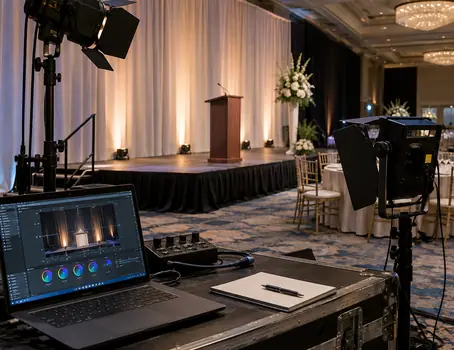
At one walkthrough, the team mapped the lighting grid around skin-tone accuracy. Magenta and blue uplights were isolated to architectural columns and kept a minimum of 15 feet from the primary speaker area. The podium received dedicated 3200K tungsten-balanced spotlights, while clean white light covered the high-tier donor tables.
That separation matters. Saturated uplighting can enrich columns, drapery, and walls while casting difficult color contamination across faces. A speaker standing between blue and magenta fixtures may appear differently colored on each cheek. Correcting that mixture later can flatten the room, distort clothing, or leave background elements looking unnatural.
Historic Rooms Need a Different Flash Plan
Historic Mid-Atlantic venues often combine dark timber, high ceilings, and divided rooms. Those surfaces absorb flash or place a usable bounce surface too far away. A white ceiling in a compact ballroom may return soft light; a dark wooden ceiling at substantial height may return almost none.
Pre-planned ambient light therefore becomes the deciding factor in image quality. The photography crew can supplement it with controlled fixtures, but the podium should already provide an intelligible direction of light. The same principle applies in rustic properties around Deep Creek Lake, Maryland, where timber interiors may contribute atmosphere while limiting reflected output.
This method assumes the venue grants advance access and the AV team can control fixture placement. Where either condition is restricted, the walkthrough should identify portable-light positions and power access before guest seating is installed.
Podium Light Check
- Verify 3200K or 5600K spotlight color temperature on the main podium.
- Keep saturated uplighting away from the primary speaker area.
- Inspect faces from the camera positions, rather than judging fixtures from the control station.
- Confirm that podium illumination remains stable during speeches and awards.
Giving the Visual Story Room to Breathe
Vendor setup runs late. The floral team makes final adjustments as the first VIP vehicle arrives. At the same moment, the planner requests pristine ballroom photographs and asks the photography crew to move lighting stands from cocktails into dinner service.
Compressing those tasks into one overlapping arrival period creates predictable gaps. The untouched room disappears as soon as coats reach chairs, the crew cannot safely carry equipment through incoming guests, and formal arrivals compete with architectural coverage for attention.
Use Visual Buffer Zones
A stronger run-of-show establishes a 45-minute visual buffer between vendor setup completion and VIP arrivals. Within that interval, the photography team receives a dedicated 15-minute window for untouched ballroom details. The remaining time supports lighting checks, equipment movement, exterior coverage, and a final review of the arrival route.
- Complete floral, linen, place-setting, stage, and sponsor-signage work.
- Clear vendor cases, ladders, carts, and personal items from photographic sightlines.
- Hold the ballroom for a 15-minute detail sequence before staff or guests enter.
- Move heavy lighting stands while public circulation paths remain clear.
- Position the arrival and cocktail coverage teams before VIPs reach the entrance.
This sequence lets the resulting gallery establish place before it introduces people. Wide views show scale, medium frames explain table design, and close details record the material choices that guests may only notice briefly.
Pacing also protects transitions later in the evening. When cocktail coverage and ballroom access overlap without a handoff interval, equipment remains in the wrong room. A visual buffer turns repositioning into a planned production task instead of a hurried movement through a crowd.
Ballroom First
The 15-minute untouched-room window should begin only after décor is complete and operational clutter has left the frame.
Finding Sponsors Without Stalling the Reception
High-priority donors, board members, and sponsors require systematic coverage, yet continuous staged introductions can strip the cocktail hour of its natural rhythm. The practical solution divides the assignment between formal capture and guided documentary work.
Keep the Step-and-Repeat Moving
A step-and-repeat operates as its own photography station. It requires a dedicated secondary photographer because the queue can persist while the lead photographer covers greetings, décor, and unscripted interactions elsewhere. Asking one photographer to alternate between both responsibilities leaves the entrance unattended or reduces cocktail coverage to fragments.
The physical queue needs equal attention. Guests should be able to enter, wait, pose, and exit without crossing the main arrival stream. The backdrop, lighting, and photographer’s working distance should stay outside the doorway’s natural pinch point. A committee representative can help identify groups before they reach the mark and release them promptly after the photograph.
Assign a Human Face Index
Rather than expecting the photography team to memorize every stakeholder, organizers can appoint a VIP spotter from the planning committee. During a designated 20-minute cocktail-hour window, that person walks with the lead photographer, identifies priority guests, and gives enough context to approach them gracefully.
The spotter should guide rather than assemble. A donor already speaking with colleagues can be photographed within that conversation, followed by a quick posed frame if appropriate. This produces useful identification coverage while preserving the atmosphere of the reception.
- Provide the spotter with the final priority list before doors open.
- Mark guests already photographed to prevent repeated interruptions.
- Flag required combinations that belong at the step-and-repeat.
- Reserve the roaming window for natural interactions and small groups.
The method has a clear operational boundary. In venues exceeding 800 guests, crowd density makes it physically impractical for a spotter and lead photographer to move between groups within a short window. At that scale, coverage should rely more heavily on fixed portrait stations, distributed committee contacts, and zone-based assignments.
Clear Angles for Speeches and Live Bidding
Seated dinners create some of the evening’s strongest expressions and its hardest camera positions. Chairs narrow the available paths, service staff move between courses, and high-value tables often occupy the most direct sightlines to the stage.
The podium introduces a specific spatial problem: the microphone stand can cross the speaker’s mouth or divide the face when viewed from the center aisle. Shifting several feet sideways may solve the composition, provided the floorplan leaves somewhere for the photographer to stand. Podium placement should therefore be assessed from likely camera angles during the walkthrough, with the microphone height and lectern position already established.
Design Movement Into the Seating Chart
One event designer preserved negative space around the perimeter and between key tables, creating 36-inch-wide movement aisles near high-tier donors. The photography team could change angles during speeches and follow auction activity without squeezing behind occupied chairs or obstructing seated guests.
These lanes need to remain operational. Décor cases, spare chairs, auction displays, and service trays can quietly consume the space after the floorplan has been approved. A pre-opening walk should confirm that each designated route remains clear from the ballroom entrance to the stage and sponsor tables.
Read the Auction Before It Peaks
Live auctions accelerate unevenly. Early bids may travel calmly between tables; the decisive exchange can build within moments. The auction team can help by cueing photographers just before a contested lot, a major appeal, or an anticipated bidding rivalry begins.
That warning allows one photographer to frame the auctioneer while another position covers bidders and surrounding reactions. The strongest sequence often includes the raised paddle, the competing response, the auctioneer’s gesture, and the release of tension after the winning bid. Without advance positioning, all four moments may occur behind a wall of seated guests.
Preserve The Aisle
A movement lane only works when planners protect it through setup, dinner service, speeches, and the final auction lot.
Letting Light Physics Shape the Seating Plan
A seating chart usually reflects social relationships, sponsorship levels, stage visibility, and service requirements. Photography adds a physical constraint: illumination falls rapidly as the distance between a subject and a light source increases.
The Inverse Square Law of light explains why a small floorplan adjustment can create a substantial exposure difference. Camera settings can raise overall brightness, though they cannot recreate directional light that never reached the subject. A distant VIP table may retain enough ambient illumination to be visible while losing the facial modelling, eye detail, and separation seen at tables nearer the source.
For one final seating review, the planner relocated primary sponsor tables closer to the ambient lights after examining expected falloff. The adjustment supported cleaner candid coverage without adding fixtures to guest sightlines. It also made the honored stakeholders easier to photograph during reactions, speeches, and bidding.
Map Distance Before Assigning Priority Tables
Planners can evaluate the room by marking the principal light sources, measuring the relative distance to candidate VIP tables, and checking whether centerpieces or stage structures interrupt the path of light. This review should happen with the photography and AV teams because fixture direction matters as much as nominal table proximity.
The governing fact is exact and unforgiving: in a simple arrangement, moving a subject from 4 feet to 8 feet away from a light source reduces the illumination to one-quarter of its original intensity.