From Phone Screen to Telephoto Frame in the Bridal Suite
A bridesmaid holds up an iPhone in a sunlit Maryland manor bridal suite, eager to show off a quick test shot of the finished hair and makeup. The bride glances at the glass screen and immediately winces. In that casual snapshot, her nose looks unfamiliarly prominent, her jawline curves inward, and the velvet armchair behind her seems miles away.
Moments like this can derail a morning timeline if left unaddressed.
Whenever a bride reacts to an unflattering phone photo, we immediately turn our camera LCD around to show the exact same pose captured through an 85mm prime from across the hallway. Her shoulders drop in relief. The cheekbones sit where they belong, the sweep of her collarbone looks natural, and the historic wainscoting frames her shoulders like an oil painting. Why do two cameras operating in the exact same room produce such wildly different facial proportions and background scales?
Smartphone main cameras typically use a 24mm to 26mm equivalent focal length held just 2 to 3 feet from the subject. That extreme proximity forces the foreground features outward while pushing the walls of the room backward. Shooting with an 85mm prime from 10 to 12 feet across a room doorway reduces that facial exaggeration. Across our multi-year portfolio documenting historic estates in Pennsylvania and waterfront retreats near Deep Creek Lake, Maryland, managing this relationship between focal length and physical footprint remains a quick way to build a couple's confidence in front of the lens.
Why Camera-to-Subject Distance Controls Perspective Distortion
Perspective distortion is strictly a function of where the photographer's boots are planted, and Stanford University's computer graphics lecture notes on perspective and focal length demonstrate that the optical glass itself does not bend facial features; rather, the chosen focal length dictates how close or far away the camera operator must stand to achieve a consistent head-and-shoulders framing.
Rather than relying on post-production liquefy tools—an approach we abandoned early in our studio's history because it introduces unnatural skin texture warping—we control facial geometry strictly in-camera by adjusting our physical footprint relative to the subject. The math behind this nose-to-ear depth ratio shift is unforgiving. At a 3-foot camera-to-subject distance, a nose tip projecting 6 inches ahead of the ears is 14% closer to the lens sensor, visually enlarging central facial features while shrinking the ears and receding hairline. When you back up to a 15-foot camera-to-subject distance, that same 6-inch depth between nose and ears represents less than a 3% relative distance difference, flattening perspective magnification into the balanced proportions people recognize from looking in a bathroom mirror from several feet away.
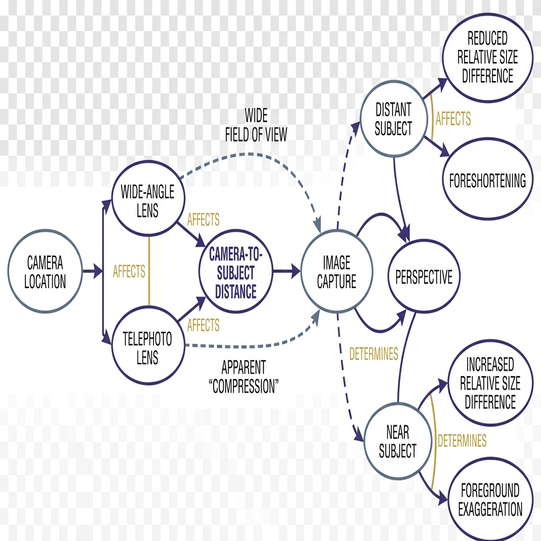
Telephoto lenses force that flattering 15-foot separation automatically, because standing any closer with an 85mm or 135mm lens would crop out the bride's forehead and chin. However, relying exclusively on long telephoto primes carries a distinct spatial limitation in regional historic architecture: long-focal-length framing breaks down inside 18th-century Pennsylvania stone farmhouses or narrow urban rowhome suites where 10-by-12-foot bedrooms physically block a photographer from backing up the required 15 feet. When a solid plaster wall stops you at eight feet and there is no doorway to shoot through, how do you adapt your focal strategy without reintroducing wide-angle distortion?
Matching 24mm, 50mm, and 135mm Primes to Mid-Atlantic Venues
During pre-ceremony venue walk-throughs across Pennsylvania estates and Deep Creek Lake, MD waterfront properties, our lead and second photographers assign dual-body prime combinations based on sightline clearances and background clutter. Typically, this means pairing a 35mm on one hip with an 85mm or 135mm on the other. Each focal tier alters how the surrounding architecture interacts with the couple.
The 24mm to 35mm Wide-Angle Tier
Wide-angle primes expand space and elongate foregrounds. They excel at pulling in vaulted timber barn ceilings, grand ballroom chandeliers, or sweeping Pennsylvania estate lawns in a single breath. Yet wide glass demands strict compositional discipline. Operating in the 24mm–35mm tier requires keeping the couple within the central 60% of the sensor grid from 6 to 10 feet away to prevent outer-edge barrel stretching while capturing vaulted ballroom ceilings. If a groom's shoulder drifts into the outer 20% of a 24mm frame, the rectilinear projection stretches his suit jacket horizontally, adding visual bulk that does not exist in reality.
The 50mm Standard Tier
When a cramped getting-ready suite or a packed tented reception eliminates the runway needed for an 85mm lens, the 50mm prime serves as the problem solver. The 50mm tier offers a 46-degree diagonal angle of view from 8 to 12 feet, matching human conversational sightlines during cocktail hour candids. Because it neither stretches the room's corners nor aggressively magnifies distant backgrounds, a 50mm lens lets the viewer feel as though they are standing right next to the laughter without altering facial geometry.
The 85mm to 135mm Telephoto Tier
Outdoors, telephoto primes act as visual scalpels. Narrowing the diagonal field of view to 18 degrees (at 135mm from 25 to 35 feet) allows a 6-foot-wide patch of autumn foliage or bay horizon to completely fill the background behind two people. If a venue's ceremony lawn borders a public boat ramp on Deep Creek Lake, Maryland, or sits adjacent to guest parking, stepping back thirty feet with a 135mm prime pulls the distant water directly up behind the couple's shoulders while melting distracting venue signage into creamy, unidentifiable bokeh.
Deep Creek Lake Framing
When shooting lakeside or mountain-view portraits, resist the urge to use a wide-angle lens to "fit in all the scenery." A wide lens shrinks distant ridgelines into tiny bands on the horizon. Step back 30 feet with a 135mm lens instead: the narrow 18-degree angle of view magnifies the distant shoreline so the water and autumn canopy tower directly behind the couple.
Step-by-Step: Pacing a Twenty-Minute Golden Hour Portrait Session by Focal Length
To maximize a narrow 20-minute sunset window without wasting time swapping lenses over dusty gravel or damp meadow grass, we pace the session outward from the venue architecture into open terrain, moving systematically from our widest mounted prime to our longest telephoto. This field sequence uses two camera bodies (or a single sequence of planned lens changes) to deliver a visually varied gallery within that window.
- Minutes 1–5 (35mm at 10 feet, f/2.8): Establish the Architectural Scale. Begin directly in front of the stone estate courtyard while the sun still clips the upper rooflines. Stand 10 feet from the couple and place them dead-center in the viewfinder to avoid edge stretching. Center-framing the couple at this distance allows you to include 30-foot stone manor facades without tilting the camera upward, keeping vertical architectural lines parallel and clean.
- Minutes 6–12 (85mm at 15 feet, f/1.8): Flatten Contours on the Garden Path. Walk the couple down the formal path away from the main building and switch to the 85mm body. Back up to a 15-foot working distance as the sun dips below the tree canopy. At this range, the nose-to-ear depth differential drops below 3%, giving faces more balanced proportions in intimate head-and-shoulders portraits while compressing distant boxwood hedges into soft tonal gradients.
- Minutes 13–20 (135mm at 30 feet, f/2.0): Isolate Backlit Foliage and Erase Clutter. Move into the open meadow edge for the final seven minutes of warm directional light. Position the couple 40 feet in front of a single backlit maple tree, then back up until you are standing 30 feet away from them with the 135mm prime at f/2.0. With this arrangement, the lens's narrow 18-degree field of view magnifies that single glowing tree canopy to fill the entire frame behind their silhouettes, completely masking an adjacent 50-car gravel parking lot and catering trucks.