Last winter I spent in the vicinity of three weeks re-cataloguing an old storage volume of wedding galleries shot between 2010 and 2013. The files were technically immaculate: every lash separated, every lace thread resolved, every highlight clipped to a clean white. And they looked old. Not old in the way a scanned medium format negative from a 1970s reception looks old, which is to say warm and lived-in, but old in the way a phone from that era looks old. The sharpness had a date stamp on it.
That contrast is what pushed me toward analog emulation as a deliberate archival strategy rather than a styling whim. What follows is the reasoning, the color science underneath it, and a worked recipe you can run on your own reception files tonight.
Contents
- When Hyper-Sharp Galleries Started Looking Dated
- Grain Clusters, Halation, and the Memory Response
- Taming Digital Neon Greens Into Portra Foliage
- Protecting the Raw File Before the Emulation Layer
- A Portra 400 Recipe for a Dim Lakeside Reception
When Hyper-Sharp Galleries Started Looking Dated
A wedding gallery has an unusual job. Most commercial imagery is consumed within a year and then retired. A wedding archive gets opened on anniversaries, passed to children, printed for a funeral slideshow on the order of forty years later. It has to survive the aesthetic preferences of generations that have not been born yet.
Clinical sharpness does not survive that trip well. When a sensor renders skin with microscopic texture fidelity and renders a white dress as a mathematically pure block of 255 with standard settings, the image carries the fingerprint of its capture technology more loudly than it carries the moment. Technology fingerprints age. Emotion does not.
There is a second loss, subtler and harder to argue in a client meeting. Couples describe their memories in tactile language. They talk about the heat of the afternoon, the weight of a grandmother's hand, the smell of pine coming off the water at a Deep Creek Lake, Maryland reception. A hyper-clean file translates none of that. The organic warmth people associate with printed photographs comes from physical artifacts: dye layers, paper texture, light scattering through emulsion. Strip all of it away and you hand someone a very accurate document of an evening they remember as something much softer.
Anchoring a gallery in analog conventions is a hedge. Digital editing fashions rotate every few years, and each rotation leaves a cohort of galleries stranded in a particular look. Film conventions have been stable for the better part of a century because they were dictated by chemistry rather than by sliders.
Why Sharpness Ages
Resolution is a property of the equipment. Tonality is a property of the picture. Galleries that lead with the second one age more gracefully than galleries that lead with the first.
Grain Clusters, Halation, and the Memory Response
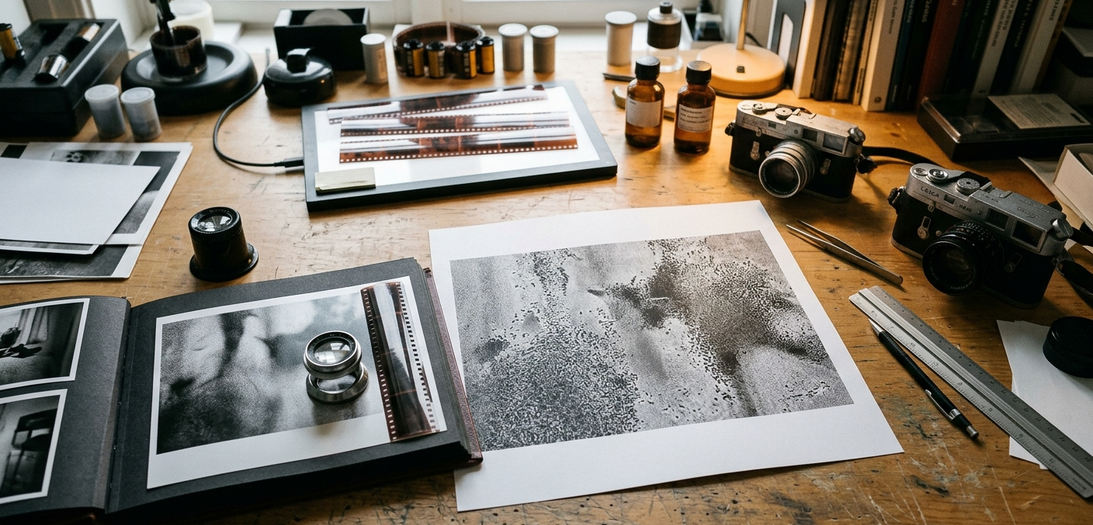
Film grain and digital noise are not interchangeable, and the eye knows it before the brain can explain why. Silver halide crystals are distributed randomly and cluster irregularly, which reads to our visual system as organic texture. Sensor noise arrives as a uniform statistical field across the frame, which reads as a defect.
My first attempt at grain emulation ignored that distinction entirely. I applied a uniform digital noise layer across the full frame at a modest opacity and called it done. The result flattened the image: shadows that should have fallen away into depth became a gray fog, and the sense of three-dimensional separation between a couple and a dark treeline collapsed. I abandoned that approach and rebuilt it around scanned 35mm grain mapped specifically to midtone luminance values, roughly the 40 to 60 band on the IRE scale. Grain lives where the eye is already looking, and the deep shadows stay clean.
Halation and the Softening of Memory
Halation is the faint red-orange bloom that appears around bright highlights on film, caused by light passing through the emulsion, bouncing off the backing, and re-exposing the layer from behind. String lights at a barn reception. Candle flames on a long table. A window behind a first dance. On film those sources glow outward instead of terminating at a hard edge.
Psychologically this matters more than it should. Human memory does not store hard edges; it stores impressions that soften around the intense parts. Halation reproduces that softening optically, and the image starts to feel the way remembering feels rather than the way observing feels. Viewers stop auditing the frame for sharpness and start reading the relationship between the two people in it.
Taming Digital Neon Greens Into Portra Foliage
Here is where most emulation attempts fall apart, and it is a color model problem rather than a taste problem.
Physical film is subtractive. Dye layers remove wavelengths from transmitted light, and because those layers interact, no channel responds in isolation or linearly. A digital sensor is additive and painfully linear: it counts photons per channel and reports them faithfully. Faithfully is the problem. Shot in open shade at a lakeside ceremony, that linearity produces foliage in a saturated, slightly electric green that no film stock has ever rendered, and that green reflects onto skin and turns it sallow.
The correction runs through the HSL panels in three coordinated moves. Shift the green hue toward yellow so the foliage sits in a golden rather than a cyan-leaning spectrum. Drop green saturation by a moderate margin so the background recedes. Then lift green luminance slightly so the shift does not read as mud. Once the environment stops shouting, warm skin tones have room to sit forward in the frame the way they do on a Portra negative.
Contrast needs the same non-linear thinking. Film does not clip; it compresses. Shadows lift gently off pure black and highlights roll off over a long shoulder before reaching white. A digital S-curve applied symmetrically will crush both ends and produce a harsh, contrasty file wearing a film costume. The curve has to be asymmetric, generous in the shadows, extremely gentle at the top.
Green Before Skin
Correct the foliage first. Skin tones in outdoor venues inherit a color cast from whatever surrounds them, so adjusting faces before the environment means adjusting the same problem twice.
Protecting the Raw File Before the Emulation Layer
Aesthetic decisions and archival decisions have to be kept in separate drawers. A film look is an interpretation of a wedding; the raw file is the evidence of it. Destroy the second to achieve the first and there is no route back when taste shifts in fifteen years or thereabouts.
The workflow I settled on builds a clean base raw conversion first, one that does nothing except protect highlight data and establish neutral tonality. That conversion is the archival state. Every emulation profile, grain overlay, and halation bloom afterward lives as a secondary adjustment layer stacked on top of it. The underlying asset stays untouched and fully recoverable.
Capture discipline carries half the weight. Blown digital highlights cannot be rescued into film's gentle roll-off, because there is no data left to roll off. A clipped channel is a flat plane of nothing. Calibrating your sensor's true highlight headroom, and then exposing to preserve it, is the precondition for everything in the color section above.
One honest limitation worth stating plainly: these emulation profiles behave badly on high-ISO files. Existing sensor noise compounds with the simulated grain, and the shadow detail in a dim reception turns muddy and directionless. The techniques described here assume reasonably clean capture; they repair aesthetics, not underexposure.
High-ISO Caution
If a reception file is already noisy, denoise conservatively before any grain overlay touches it. Stacking real noise under synthetic grain produces texture that reads as neither.
Modern high-resolution sensors are genuinely useful here. There is enough underlying detail that a scanned grain overlay sits on the surface as texture without eating into the subject itself, which is what happened when the same overlays were applied to lower-resolution files a decade ago.
A Portra 400 Recipe for a Dim Lakeside Reception
Let me walk through an actual case rather than describe one abstractly. Picture a September reception on the water at Deep Creek Lake, MD: a covered pavilion, bistro bulbs strung overhead, pines going dark behind the dance floor, ambient light somewhere around candle-and-bulb level by nine o'clock.
- In camera. Set the picture profile to neutral or flat to maximize usable dynamic range, then expose slightly to the right. In a venue this dark the instinct is to underexpose and lift later, which buries shadow detail exactly where the grain structure needs clean information. Watch the bistro bulbs on the histogram and keep them off the right wall.
- Base conversion. Build the archival raw conversion with highlights recovered and nothing else applied. White balance to the warm side of accurate, around the temperature of the bulbs rather than neutral daylight. Save this as the master state.
- Tone curve. On the RGB curve, lift the black point by 10 to 15 points to produce the faded shadow characteristic of slightly underexposed Portra 400. Pull the white point down a comparable amount so the bulbs bloom softly instead of punching. Shape the midsection into a shallow S, favoring the shadow side.
- Greens. In HSL, shift the green hue toward yellow, reduce green saturation moderately, and nudge green luminance up. The pines behind the dance floor should read as warm darkness rather than as a cyan wall competing with the couple.
- Grain. Apply the scanned 35mm overlay, masked to the 40 to 60 IRE midtone band. The dance floor and faces carry the texture; the pavilion ceiling and the treeline stay clean and deep.
- Halation. Add a narrow red-orange bloom confined to the brightest highlight edges only. The bistro bulbs and the reflection line on the lake glow. Nothing else should.
Run that sequence on a single frame, export a proof, and compare it against your untouched base conversion at full screen. The base will look more accurate. The graded version will look like the night actually felt from inside it, which is the version the couple will still want on a wall in circa thirty years.