Contents
- The Four O'Clock Glare on a Miles River Dock
- Reading the Sun's Arc from Gibson Island to Oxford
- Brick Manors, Teak Piers, and Glowing Sailcloth
- Thermal Breeze, Salt Haze, and the Summer Squall
- Writing the Wedding Day Around Tides and Seasons
The Four O'Clock Glare on a Miles River Dock
Picture a July afternoon on a manor dock along the Miles River. It is four o'clock, and the bride stands at the end of the pier, squinting, with nowhere obvious to look. The sun sits high over her shoulder. The river, brackish and lightly choppy, throws a second sun back up at her chin.
Couples book Chesapeake Bay estates for the water. Then a standard afternoon ceremony timeline turns that same water into the harshest reflector on the property.
The physics is simple once you see it. Between June 15 and August 10, a 4:00 PM portrait combines direct overhead sun with an upward bounce off the river. Holding the pattern in Alençon lace without crushing the shadows under the brow ridge then demands a 4-to-5 stop dynamic range compression. The lace wants to clip. The eye sockets want to go black. The water fills from below, though never evenly enough to rescue the face.
We learned the limits of brute force during lighting tests on a Miles River dock one July. Our first instinct was the textbook setup: portable softboxes at 45 degrees to the couple, powered up to overpower the glare. It failed on two fronts. The strobe output needed to beat the dual reflection off the chop constricted the couple's pupils into pinpoints, and their skin picked up a hot, sweaty sheen that no retouching pass made graceful. So we stopped fighting. We turned the couple's stance toward the riparian buffer, the strip of marsh grass and shrubs along the bank, and let the water work strictly as a rim light behind them.
That pivot taught us the central lesson of Chesapeake wedding photography. The water is a light source with a direction, and the shoreline's orientation decides whether it behaves like a hazard or like the largest softbox you will ever own.
Reading the Sun's Arc from Gibson Island to Oxford
Maryland's two shores face each other across the bay, and they light a wedding in opposite ways. Western Shore venues around Annapolis, the Severn River, and Gibson Island look east over the water, so their gentlest light arrives in the morning. Eastern Shore estates in St. Michaels, Oxford, and on Kent Island look west, and their docks catch the evening sun.
Tidal creeks versus open bay
Surface texture matters as much as direction. A calm morning inlet on the Western Shore breaks specular highlights into a soft, pastel wash, the kind of diffused backdrop that flatters veils and pale florals. A west-facing Eastern Shore dock on open water delivers something bolder: direct golden-hour backlighting skimming across the surface, outlining hair and shoulders in warm light.
The sun also moves through the season. Along the Mid-Bay region, the sunset azimuth swings from roughly 298 degrees WNW in late May to 248 degrees WSW by late October. That 50-degree shift changes the angle of reflection across every fixed dock on the water, which means a pergola aligned beautifully for a spring wedding can aim straight into the glare by autumn.
The open-water golden-hour rule holds on broad stretches of bay, and it breaks down on winding tributaries like the Tred Avon or the Wye River, where maritime oaks on the opposite bank cut off direct sun 40 to 50 minutes before official civil sunset. Plan your ceremony against the tree line rather than the almanac.
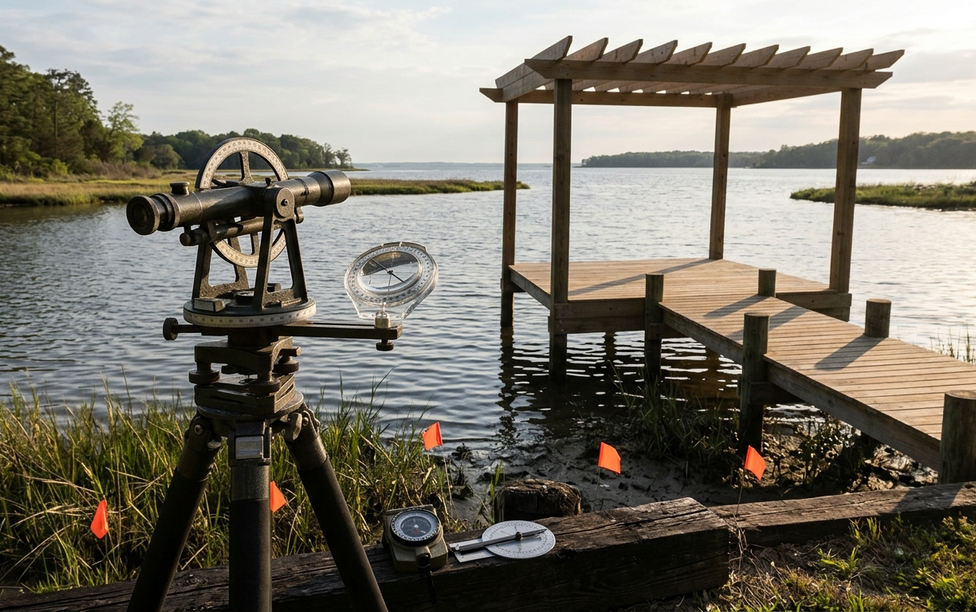
A compass check during the venue walk-through
We map the solar azimuth on site instead of trusting a venue's default pergola alignment. The routine is short:
- Stand at the ceremony focal point and open a compass app; note the bearing the couple will face.
- Look up the sunset azimuth for your wedding month, comparing a May date against an October date if the venue hosts both.
- Mark where the sun will sit relative to the pergola at ceremony time, and where its reflection will land on the water.
- Work with the event planner to rotate seating so the couple faces about 30 degrees off the primary glare axis; a shift of 25 to 35 degrees relative to the shoreline prevents direct squinting while keeping the bay horizon in frame.
Question the Pergola First
A permanent ceremony structure was positioned for a view, not for your date's sun. Confirm its bearing before you finalize the ceremony time.
If thirty degrees of rotation keeps the horizon and saves the bride's eyes, why would anyone leave the chairs where the rental company dropped them?
Brick Manors, Teak Piers, and Glowing Sailcloth
Three kinds of architecture recur along the Chesapeake, and each asks for a different technical answer.
Tidewater Georgian brick manors from the 18th century offer deep window reveals and warm masonry. Their interiors read rich and directional, and the red brick pushes skin tones warmer, so we watch white balance closely when a portrait moves from the lawn into a front hall.
Sailcloth tents pitched on waterfront lawns create the most dramatic mixed lighting of the day. Inside, un-gelled tungsten cafe bulbs burn at about 2700K. Outside, the cobalt twilight over the bay climbs to 7500K or 8000K. Shoot without correction and the bay turns a muddy gray behind the couple. We calibrate custom kelvin profiles on location and put a 1/2 to Full CTO gel on our off-camera strobes so the flash matches the warm glow of the canvas peak. That balance holds only through a blue hour window of about 25 minutes, so the reception timeline should leave room for it.
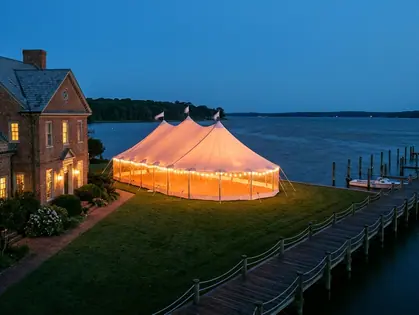
Weathered yacht club piers are narrow, typically 6 to 8 feet wide, which crowds any group composition. A wide-angle lens near timber pilings bends them toward the frame edges and stretches the people standing closest. The cleaner approach is to step back about 40 feet onto the lawn or an adjacent bulkhead and compress the scene with an 85mm or 135mm focal length. The pier stays straight, the wedding party stays in proportion, and the water fills the background.
Timing matters on the docks too. Schedule pier portraits before cocktail hour, when boat traffic picks up and heavy wakes start rocking the boards and breaking up the reflections.
Thermal Breeze, Salt Haze, and the Summer Squall
By midafternoon in high summer, the land across the Delmarva Peninsula heats faster than the water, and the bay answers with wind. Between 2:30 PM and 5:30 PM in July and August, thermal pressure gradients regularly generate a 12-to-18 knot southerly or southwesterly breeze off the bay.
That breeze shapes decisions well before anyone reaches the dock. A cathedral-length silk tulle veil becomes a sail; for dockside portraits we switch to heavier veils with beaded edge weights. Arbor florals need secure mechanics rather than loose stems. Hairstyles with structure, such as low chignons and pinned braids, survive a gust that would wreck soft, loose waves.
Humidity changes the view itself. Summer afternoon relative humidity often hovers between 75% and 85%, building a salt-and-moisture aerosol layer that obscures shorelines beyond about 1.5 nautical miles. The far horizon flattens into a soft, painterly gradient. Wide landscape frames lose their depth, while tighter medium-format portrait focal lengths turn the haze into a gentle backdrop.
Shoot Into the Haze
On a hazy July afternoon, choose the longer portrait lens and let the bay dissolve behind the couple instead of chasing a crisp distant shoreline.
When a squall rolls in
Chesapeake summer storms move fast, and a contingency plan keeps the editorial look intact:
- Scout the deepest wrap-around veranda on the estate during the walk-through; its covered edge gives open, directional light with the water still visible.
- Identify a historic carriage house with large doors facing away from the incoming weather for natural-light portraits.
- Keep the portrait list short and flexible so the strongest frames can move indoors without a full reset.
If the storm passes in twenty minutes, will your timeline let you walk back out for the rain-washed light that follows?
Writing the Wedding Day Around Tides and Seasons
Spring and summer give a photographer time. Twilight lingers, and the blue hour over the water stretches long enough for both sunset portraits and a calm reflection series after dinner. Autumn moves faster: the sun drops quickly behind tree lines and old maritime oaks, so October portraits belong earlier in the afternoon, often before the cocktail hour begins.
Tides deserve the same attention as the sun. We check the nearest subordinate station in NOAA Tides and Currents for the Chesapeake Bay six months before the wedding and lock a 45-minute portrait window at low-to-mid tide. At that stage of the tide, sandy coves and riprap shorelines show their texture, and couples can walk out onto the sand instead of posing from the top of a bulkhead.
The mid-Chesapeake's mean tidal range is modest, only about 1.2 to 2.5 feet, yet wind can override the prediction. A sustained 15-knot southerly can push water nearly 1.5 feet above predicted high tide and submerge a narrow beach entirely. Pair the tide table with the afternoon wind forecast during wedding week.
Lock the Low-Tide Window
Set the shoreline portrait slot by the tide chart months ahead, then confirm it against the wind forecast as the date approaches.
All of this comes back to orientation. The Chesapeake Bay's shoreline, counting every tidal tributary, creek, and island, runs for roughly 11,684 miles, so two estates only 5 miles apart by land can face 180 degrees away from each other, one lit by sunrise on the water and the other by sunset.